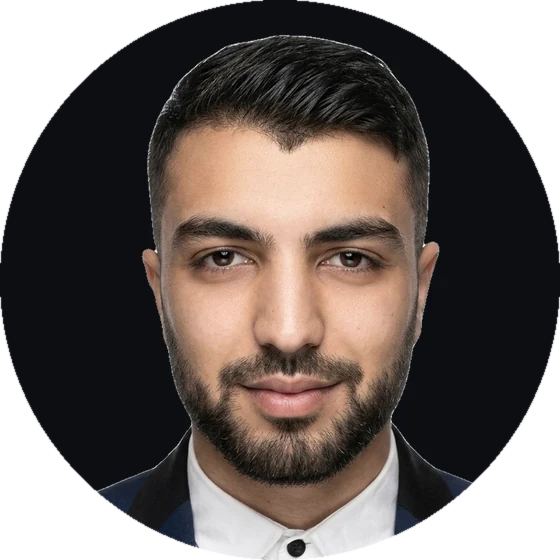
The story
01 — Lille
Where it started
I grew up in a Moroccan family in Lille, in a house where school was never really optional. Both my parents are teachers — my father teaches physics, my mother teaches Arabic — and doing well in school wasn't a choice so much as the baseline. I was good at it, which made everything that came after harder to explain.
We're also a family of migrants, and my parents left the mountains of Morocco so their kids could have a shot somewhere else. In a family like ours, success isn't just hoped for. It's closer to a duty, for everything the generation before gave up to get us here.
By the time I finished high school in 2016, the plan was set: two more years of intensive maths and geopolitics, France's pressure-cooker track into its top schools. I did the two years. I was also tutoring math on the side for extra money, without really thinking of it as a business yet.
02 — The raffle system
A system, not a job
At 19 I built the first thing I'd call a real business: a system where more than 30 people entered sneaker raffles, and whenever one of them won a pair, I bought it off them and resold it. It made a few hundred to a few thousand euros a month.
It wasn't much money in absolute terms, but it was the first time I understood how a business actually works, instead of just doing a job: buy low, sell higher, and repeat it enough times.
03 — Argan oil
The day I told my father
Telling my parents I was dropping out of school was hard in a specific way. I'd always been good at school, and in a house with two teachers, that was the whole point of me. The day I told them anyway, I already had the next thing lined up: an argan oil brand, launched with a friend using our family's connections in Morocco.
We ran it ourselves — production, shipping, tens of liters a month across France and Belgium. My parents have always been supportive, and once they saw it actually working, any worry gave way pretty quickly.
What we never had was the capital to scale a physical product, and no amount of hustle fixes that. It was a good venture. It also taught me what I didn't want to build again.
04 — Crypto & audience
The lesson that stuck
The third venture was a media page about crypto, paired with an education platform. It's the one that taught me the lesson everything I do now is built on: an audience gets you customers for free, and digital products are high margin with almost nothing needed to start them.
It takes months, sometimes years, to build a community that actually listens. Once it does, it's revenue that doesn't need you chasing it. Somewhere in the same stretch I also ran a dropshipping store on Facebook ads and influencer marketing, back when that was still new.
05 — Advising, unofficially
The job before the job
Around 20, without calling it anything, I started doing what is now Jbilou. A friend launching a videomaking service business came to me with questions about pricing. Another, starting a DJ controller brand, needed help with positioning.
I said yes, then kept saying yes for years — to the pricing questions, the "why isn't this working" questions, whatever came next. It never felt like a job. It just kept happening.
06 — INSEAD
A different room
At 25 I did a Master in Management at INSEAD. It was a jump — from a normal French university to a room full of people from MIT, Oxford, schools I'd only ever heard of. I got there on my grades in maths and, I think, on the three ventures behind me.
I was the first person from where I'm from to sit in that room, and I noticed it most days.
07 — OC&C, London
Learning to think in straight lines
Then two years at OC&C in London, on strategy and deal work: a £1bn holiday-operator IPO, the sale of a procurement-software business across France and Belgium, and more than twenty projects in total.
The one I think about most is the international expansion strategy for a UK fitness operator that didn't know where to go next. We clustered cities by gym penetration and ability to pay until clear poles showed up on the map. A year later, they'd opened ten clubs abroad. That's where I learned to turn a messy question into something you could actually act on.
08 — Now
Traxo + Jbilou
At 28, I'm leaving to build again. Traxo is a customer-acquisition SaaS for service businesses. Jbilou is the advising I've been doing since I was 20, finally made official — sessions and projects with people building online, one problem at a time.
Starting October 2026, I'm documenting the year on video, once a month: the decisions, the numbers, and what goes wrong, as it happens.
09 — Why Jbilou
The name
Jbilou means "mountain guy" in Moroccan Arabic. That's my family — people from the mountains, generations before Lille.
The CV reads INSEAD and London. None of it starts there. It starts with a family that left the mountains so the next one could go further. Keeping the name keeps that honest.